Cyprus Culture Exam Day: What to Bring and How It Works
Bring your passport or ID card, your candidate card (Δελτίο Υποψηφίου) with the invitation letter, and a blue pen — nothing else. Arrive at least 30 minutes early: once 20 minutes have passed from the start, nobody is let in for any reason. The exam lasts 45 minutes, you circle your answers on the answer sheet in blue pen, and you cannot leave the room until 30 minutes after the start.
The rules below come from the «Οδηγίες προς υποψηφίους» (instructions to candidates) that the Examination Service emails with the invitation letter, and from the instructions printed on the answer paper itself. The Ministry does not publish them on its website. Where we rely on candidates' experience rather than the official text, we say so.
What to bring
| Item | Details |
|---|---|
| ID card or passport (Δελτίο Ταυτότητας / Διαβατήριο) | Ideally the document whose number you gave when you paid on JCC. Without it you are not admitted |
| Candidate card (Δελτίο Υποψηφίου) and invitation letter (επιστολή συμμετοχής) | Emailed from [email protected]. You show the letter together with your ID — without them you are not let into the room |
| Blue pen | Blue is the only colour allowed. Bring two in case one runs out |
Your ID and the letter stay on the desk for the whole exam so the invigilator can check them. You cannot take your phone out during the exam, so print the letter beforehand to be safe.
What you cannot bring
The official list of banned items:
- mobile phone;
- books;
- notes;
- dictionaries;
- pencil cases;
- coloured pens;
- correction fluid or tape;
- pencils;
- erasers;
- any other item.
The last line covers everything else — smartwatches, earbuds, smart glasses. The exam supervisor and the invigilator ask candidates to put away anything beyond the essentials and keep checking until the end. A bottle of water, in candidates' experience, is usually allowed on the desk.
When and where to arrive
- The venue and time are in your invitation letter. Go to the exact examination centre it names: candidates report that another centre will turn you away. In July 2026 the exam ran in two rooms, at 09:00 and at 11:00, with different papers.
- Arrive at least 30 minutes before the start.
- 20 minutes after the start, nobody is admitted for any reason.
- Only candidates are allowed into the centre — no one can come in with you.
- In the room, sit where the invigilator tells you and stay in that seat until the end.
How the exam runs
- The envelope with the papers is opened by the invigilator in the room at the start, and you are asked to check the number of pages in your booklet.
- All answers go in the booklet you are given. On the cover, in the box at the top left, you write your full name, candidate number and ID number. When you hand in, the invigilator covers these details with an opaque sticker in front of you.
- For rough work there is a separate page marked ΠΡΟΧΕΙΡΟ. Do not answer there: anything not transferred to the answer sheet is not marked.
- You cannot ask the invigilator questions. The rules say the papers are worded clearly enough, so no clarification is allowed. Invigilators, in candidates' experience, often speak only Greek.
- For the first 30 minutes nobody may leave the room for any reason. After that you may leave, but you hand in your paper first and cannot come back.
- Tearing out or removing pages from the booklet is forbidden.
- At least two candidates must be in the room at all times. If you and one other person are the last two left, you cannot leave before them.
- When time is up, the invigilator tells everyone to stop writing and stay seated, then collects each paper in turn. Everyone hands in their booklet and signs the hand-in list.
- Once you leave the room, move away from it straight away.
How to fill in the answer sheet
The exam has 25 multiple-choice questions (format and pass marks in About the exam). The options are labelled with the Greek letters Α, Β, Γ, Δ, not A, B, C, D.
The rules printed on the paper:
- All answers go on the answer sheet (Φύλλο Απαντήσεων). Answers that are not on the answer sheet are not marked, even if you ticked them next to the question.
- One answer per question.
- Circle the letter of the correct answer.
- Changed your mind? Cross out the old circle with a single X and circle the new letter.
This is how the example on the paper looks: in question 1 answer Α is circled; in question 2 the candidate changed their mind — the circle on Α is crossed out with a single X and Γ is circled.
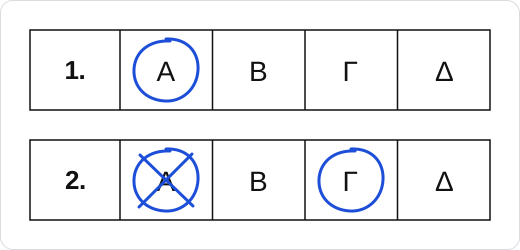
Correction fluid and erasers are banned, so this is the only way to change an answer.
«Διαγραφές γίνονται με ΧΧΧΧ» — four crosses? No. That is the general rule for anything you write: cross out, never erase. On the answer sheet the example shows one X over the old circle, with the new answer circled next to it.
What gets you removed from the exam
Any of the following means removal from the room and exclusion from the exam:
- talking or any other contact with other candidates, passing items, copying;
- dictionaries or any other aids;
- a mobile phone — you may neither use it nor have it on you;
- not following the instructions of the exam supervisor or the invigilator.
The Hallouminati app and bot are the easiest way to prepare for the questions themselves: past-exam questions in Greek, with the same answer options.
FAQ
What do I bring to the Cyprus culture exam?
Your ID card or passport, your candidate card (Δελτίο Υποψηφίου) with the invitation letter, and a blue pen. Nothing else is allowed in, including your phone.
Can I bring my phone if it is switched off?
No. The phone is on the banned list and you may not even have it on you. Leave it at home or in the car.
I am running late. Will they let me in?
Only within the first 20 minutes after the start. After that nobody is admitted for any reason. You are expected 30 minutes before the start.
What pen do I use?
Blue only. Coloured pens, pencils, erasers and correction fluid are all banned.
How do I change an answer?
Cross out the old circle with a single X and circle the new letter. You cannot erase or white out.
The rules say «ΧΧΧΧ». Do I need four crosses?
No. «ΧΧΧΧ» in the general rules means "cross out, don't erase". On the answer sheet the correction example is a single X over the old circle.
Does an answer marked next to the question count?
No. Only the answer sheet is marked. If you marked answers in the question booklet, copy them onto the answer sheet before time is up.
Can I ask the invigilator what a word means?
No. The rules forbid clarification questions, and invigilators often speak only Greek. You need to know the exam vocabulary in advance.
Can I leave early?
After 30 minutes, yes — but you hand in your paper first and cannot come back.
Do I need to print the invitation letter?
The rules require you to show it together with your ID, and you cannot take your phone out during the exam. Printing it is the safe option.
Can I bring water?
Water is not mentioned in the official list. In candidates' experience, a bottle of water is usually allowed on the desk.
💬 Still have questions? Ask them in our Telegram community — Cyprus Culture Exam — where other candidates share their experience and help each other out.
See also: About the Cyprus culture exam · How to prepare · Registration · Results